Courses
Practical courses in two tracks — professional soldering and surface mounting for production, and home-electronics repair. We have been running them since 1996.
Soldering & SMT
Practical training in soldering and surface mounting, intended for production technicians. The goal is to acquire fundamentals and gain practical skill in soldering and mechanical operations in electrotechnics. Courses take place at our facility; by agreement, we can run a course at the customer's site. The schedule is typically theory in the morning, practice in the afternoon — adjustable on request.
The courses suit both technical-secondary-school students and experienced professionals, and serve for requalification, upskilling, or onboarding new staff. A course can also be taught in English, and partly in Russian. Theory is delivered by university lecturers. The minimum number of participants is 4. A training manual is supplied on request.
Courses are usually offered at three difficulty levels — BASIC, MEDIUM and HIGH.
Lectures
Theoretical part: two-day course 2× 3 h, one-day 1× 3 h. A combination of the following topics can be selected.
- Function and construction of electronic components — classical (PTH) and SMD packages.
- Design and construction of classical (PTH) components.
- Design and construction of SMD packages.
- Handling of components, including antistatic protection.
- Antistatic workplace requirements and the principles of working with ESD- and moisture-sensitive components.
- New designs in electronics and microelectronics.
- PCB layout topology, including the differences between design for wave and reflow soldering.
- Introduction to PCB manufacturing and currently used technologies.
- Surface finishes and choosing them for solderability and reliability.
- Assembly, soldering and inspection processes — including fluxes and cleaning agents.
- Reliability of the solder joint.
Workstations and skills
Practical part: two-day course 2× 4 h, one-day 1× 4 h.
- Manual soldering and repair of through-hole (PTH) designs — cables and connectors, electronic desoldering, bottom preheating and mini-wave.
- SMT soldering and rework of surface-mount parts — chip packages down to 0402, cylindrical packages, Flat-Pack and others.
- Option to run the course on your own printed circuit boards.
- Hands-on contact technology and hot-air soldering.
- QFN and BGA soldering training.
- Solving a specific problem from your production during the course.
- Repair of solder pads on printed circuit boards.
- BGA package repair — reballing.
- Optional excursion through SMTplus production.
Each two-day-course participant assembles a simple board by hand-soldering as proof of skill. Every participant receives feedback and a certificate of completion.
Workplace equipment
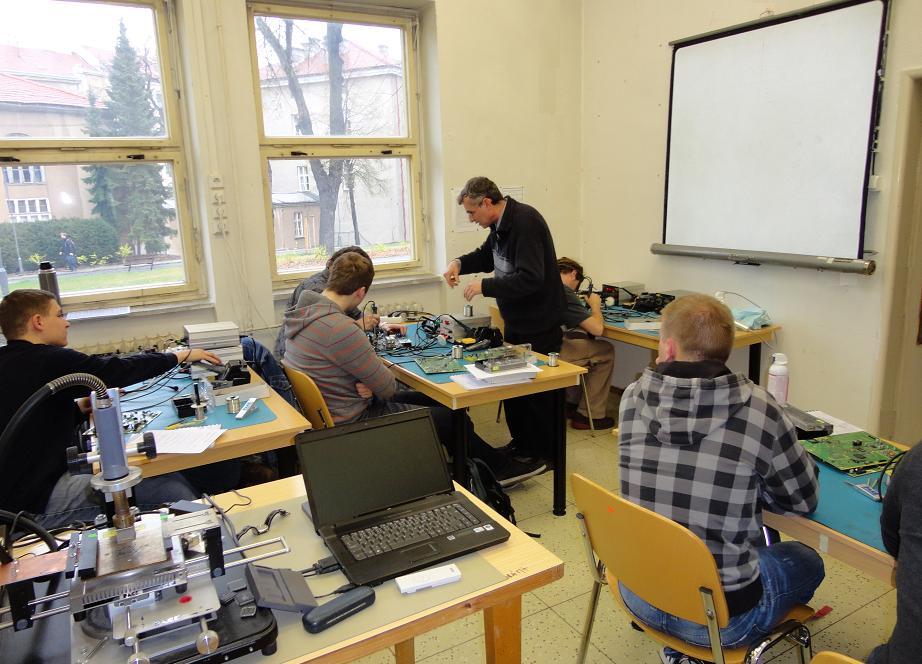
Each pair of participants has at least the following on a workbench fitted with an anti-static mat:
- temperature-controlled PACE soldering station, soldering handpiece with two tips (small and large mini-wave), electronic desoldering tool and soldering tweezers with chip-component tips;
- a tip set for contact and contactless component removal/placement;
- hand tools, a watchmaker's loupe and solder wick;
- a tray with various package types;
- cored solder wire (standard SAC305 and SN100C) and paste flux in a dedicated applicator (No Clean);
- a test soldering board for package-soldering training;
- cleaning agents.
For all participants: electronic and manual desoldering tools with suction tips, hot-air desoldering / soldering rework, and inspection equipment for visual joint control.
Standards
All theoretical and practical training is conducted in line with the relevant European and Czech ČSN EN and American IPC standards.
Course materials
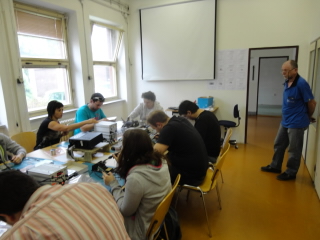
From the courses
Register interest — soldering / SMT
Let us know your preferred level, language and approximate date. We confirm dates once the group is filled (minimum 4 participants).
Home-electronics repair
SMTplus.CZ Ltd. offers a practical course covering repairs of home electronic appliances. The course builds on experience from teaching practical electronics at VUT FEKT Brno and on current trends toward thrift and reuse. The goal is to acquire basic theoretical knowledge and the practical ability to carry out small repairs of household electronics. Courses are held at our facility. The schedule is typically theory in the morning, practice in the afternoon.
Lectures
Theoretical part: one-day course, 3 hours. A combination of the following topics can be selected.
- Introduction — basic safety rules, essential equipment and where to get it.
- Construction of current and older household appliances, and principles of economical use.
- Plastics and metals used in appliances and their characteristics.
- Joining materials — screws, rivets and adhesives.
- Principles of correct soldering.
- Likely faults in common household products and recommended repair procedures.
Workstations
Practical part: one-day course, 4 hours. The following workstations will be available.
- Measuring electrical quantities with a multimeter and clamp ammeter.
- Bonding different plastics and repairs with a hot tool.
- Repairing broken casing parts, covers and dovetails — metal insert and bonding.
- Repairs on rigid and flexible PCBs — replacing components and connectors.
- Repairing torn and broken power cords.
- Removing stripped or broken screws and repairing cracked or "stripped" threads.
During the practical part, participants may — by personal agreement — repair an appliance they have brought along. Every participant receives feedback and a certificate of completion.
4 to 6 participants per course.
Register interest — repair course
Let us know your preferred level, language and approximate date. We confirm dates once the group is filled (minimum 4 participants).
Customers
Flextronics Barco SPŠ Písek Panasonic Andrew Telecommunications Elcom Kampos AŽD Symbol Technologies TAM Europe JJS Electronics Honeywell YSOFT Tyco Electronics EPCOS Šumperk STROM Telecom SIEMENS VDO Thermo Fischer Scientific Edwards Vacuum